- Hjem
- Products
- Stair-landing connections
- Instructions for stair connections
Do you want more information and pricing?
1 / 3
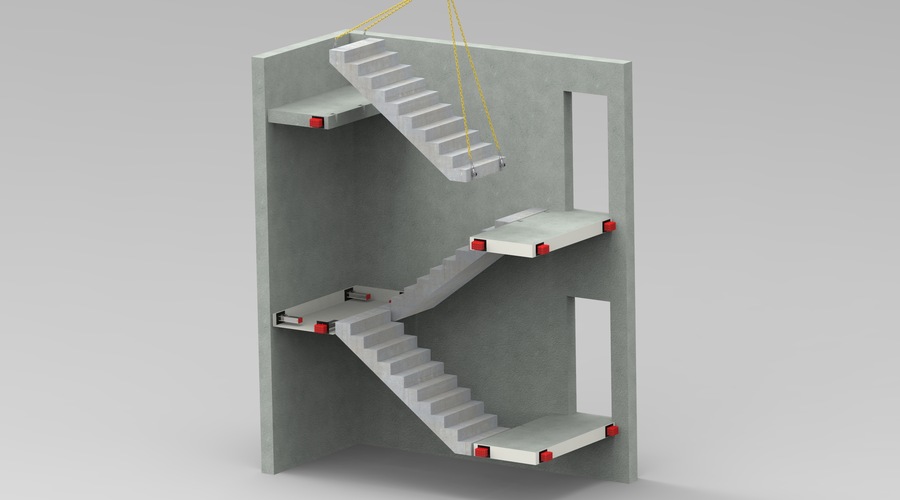
The easiest way for fixing stair and landings.
Instructions for stair connections
The most efficient, economic and sustainable way to connect concrete stairs and landings.
Cost-saving:
- Thinner landings (20-25% reduce concert consumption)
- Documented and certified solution
- Fast installation
- No need for shimming, leveling adjustment
- No extra lifting point on the stair flight needed
- Good tolerances
- Fire protection
- Safe to install
- Access stairs in the building process
Requirements for the stairs:
- Surface, Terazzo, see TSS
- Impact sound reduction see Memo no 47
- Fire protection, see page 9 memo 31 and Memo no 45
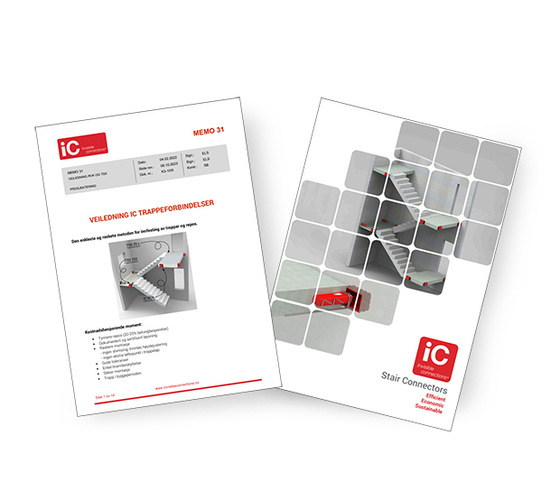
Download the guide:
In accordance with TEK17, the following pre-accepted requirements apply to stair flights. See Memo 45:
Fire class | Requirement for stair flights |
Fire class 1 | – |
Fire class 2 | R30 [B30] |
Fire | R30 A2-s1,d0 [A30] |
TSS and RVK Connectors with Integrated Fire Protection
Invisible Connections’ TSS and RVK telescopic connectors provide loadbearing connections between precast concrete stairs or landings and the supporting stairwell walls.
Memo 45 covers solutions for buildings in fire classes 1, 2 and 3 and describes how fire protection must be considered in relation to both the connection itself and the interface with the stairwell wall.
A key principle of the solution is grouting around the connection. Following installation, the recess around the connector is filled with cementitious grout, providing a mineral cover between the steel components and the fire-exposed surface.
The principle is comparable to the fire protection provided to reinforcement embedded in concrete, where the distance between the fire-exposed surface and the steel helps protect the steel components from elevated temperatures during a fire.
R Classification and Minimum Cover
R denotes loadbearing capacity under fire conditions, while the number indicates the period of fire resistance in minutes. This use of R as the criterion for loadbearing capacity is consistent with the BS EN 13501-2 classification system.
Adequate cover to the loadbearing steel components is therefore an important part of the fire protection solution for IC connectors.
Fire resistance | Minimum cover “C” |
R30 | 15 mm |
R60 | 25 mm |
R90 | 35 mm |
R120 | 45 mm |
When installing TSS and RVK connectors, there is normally a 20–30 mm air gap between the precast concrete element and the stairwell wall.
The interface with the wall and any required fire stopping must be detailed and installed in accordance with the project-specific fire strategy.
Requirements determined by the project fire strategy
The required fire resistance depends on the building's fire class and on how the staircase forms part of the overall fire strategy.
For stair flights, the pre-accepted requirements shown above are R30 for fire class 2 and R30 A2-s1,d0 for fire class 3.
Higher fire resistance requirements may apply to certain structural arrangements. This may, for example, be relevant where the staircase is not located within a separate stairwell but is exposed within the fire compartment itself. In such cases, a higher fire resistance classification, such as R60, may be required.
The applicable fire resistance requirement must be determined by the responsible fire engineer for the individual project.
Connection and Fire Protection as an Integrated Solution
With Invisible Connections’ TSS and RVK telescopic connectors, the loadbearing connection of precast concrete stairs and landings is combined with a straightforward approach to fire protection.
Once the connection is grouted following installation, the loadbearing steel components are provided with the required mineral cover as an integral part of the completed construction.
The final fire resistance requirements and detailing must be determined and documented for each individual project by the responsible designer. Interfaces with adjacent construction, any required fire stopping and the final installation must comply with the project's fire strategy.
Laboratory tested in accordance with EN 17823
A staircase is more than a load-bearing structure. Every footstep generates vibrations that can travel through the connections and into the surrounding building structure. Effective acoustic decoupling between the stair flight, landing and wall is therefore essential to limit the transmission of impact sound.
To document the acoustic performance of our solutions, Invisible Connections has carried out laboratory testing in accordance with EN 17823, the European standard for the laboratory measurement of impact sound insulation of stairs and stair isolating elements.
The standard provides a common method for documenting and comparing acoustic performance. The results can, among other applications, be used as input data when calculating the expected impact sound levels in buildings in accordance with EN ISO 12354-2.
Independent laboratory testing at STEP
The testing was carried out by STEP GmbH at a specialised acoustic stair test facility in Jettingen, Germany.
During the test, precast concrete landings were installed using four IC connections to the reference wall. An air gap of approximately 20 mm was maintained between the landing and the wall.
The test configuration is designed to minimise unwanted flanking transmission and provide controlled measurement conditions. Impact sound was generated using a standardised tapping machine positioned at four different locations on the landing. The reference wall was additionally excited using an impact hammer at twelve positions.
The measurements were carried out in accordance with the methodology specified in EN 17823, together with relevant measurement and evaluation methods from EN ISO 10140-3 and EN ISO 717-2, among others.
Tested at different load levels
The acoustic performance of the connections was investigated under different loads. Using a hydraulic press, the load on the landing was increased incrementally, with loads per TSS/RVK connection ranging from 2.7 kN to 34.6 kN. This allowed the test to document how acoustic performance is affected as the connection and elastomer operate under different load levels.
Documented results
The laboratory test demonstrates a clear reduction in impact sound transmission.
For the isolated solutions, the weighted normalised impact sound pressure level, Lₙ,w, was measured, among other parameters. The results for the individual IC products are presented under Technical Data on the respective product pages.
EN 17823 also uses ΔLw,landing, which describes the improvement provided by the connection between the landing and the wall, including the impact sound isolating element, compared with direct excitation of the reference wall.
In addition, ΔL*w,landing is stated, where the isolated solution is compared with a rigidly connected reference landing.
These values provide acoustic consultants and designers with documented data for assessing and calculating impact sound performance in buildings.
Resilient acoustic decoupling
IC solutions use elastomeric material for vibration isolation to limit the transmission of structure-borne sound between the concrete stair or landing and the surrounding structure.
The profiled IC elements allow the elastomer to deform under load and recover its shape when the load is reduced. At the same time, a sufficient damping area is important to achieve the required acoustic performance.
Invisible Connections applies a design principle with a recommended damping area of 200–250 mm² per kN of ultimate load.
EN 17823 and European impact sound requirements
EN 17823 is a test standard, not a common European requirement specifying maximum impact sound levels in buildings. Specific requirements for completed buildings are established through national building regulations and standards and vary between countries, building types and applications.
EN 17823 instead provides a common European method for measuring, documenting and comparing the acoustic performance of stairs and stair-isolating connections.
This enables documented product data to be used as a basis for acoustic design and for assessing solutions against national impact sound requirements.
From laboratory testing to the finished building
Laboratory testing in accordance with EN 17823 provides documented data on the acoustic performance of IC connections. This gives acoustic consultants, precast manufacturers and contractors a more reliable basis for selecting and designing solutions where effective control of impact sound is essential.
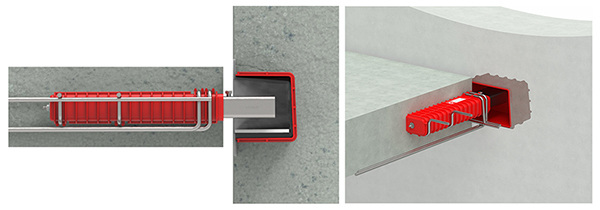 TSS – Terrazzo Stair Support Inner tube pulled out with a wire and return rope. No visual marks in the surface of the landing. |
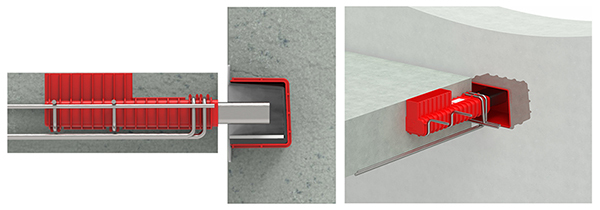 RVK – Repos Vegg Konsollfritt |
| Article no | Description | Capasity | Picture |
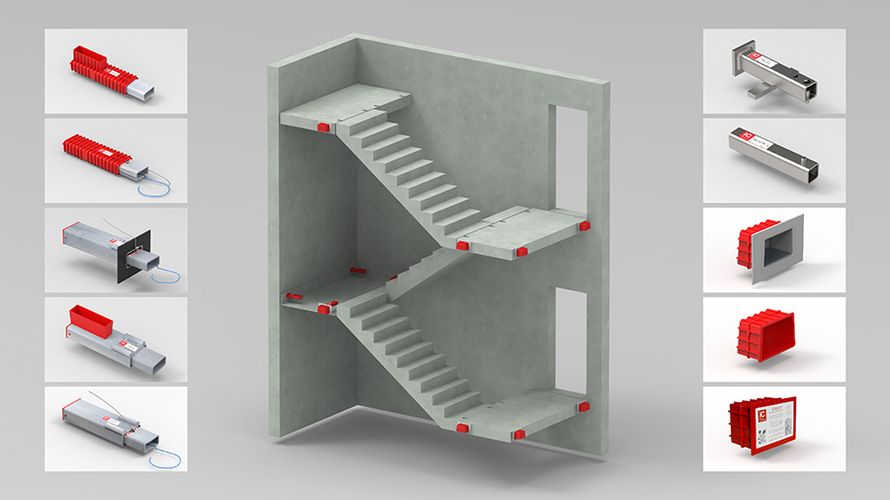
| TSS 60 P | Slim design allows thinner landings all the way down to ≥120 mm (full capacity 170 mm). Outer tube made of recycled HDPE. | 57kN | 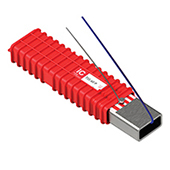 |
| TSS 101 | Connector capacity up to 96 kN in a minimum 170 mm thick landing increasing to 100 kN for 200 mm thick landing. | 100kN | 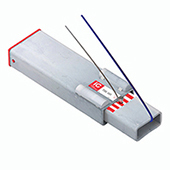 |
| TSS 102 | Included impact sound reducing rubber. Connector capacity up to 96 kN in a minimum 200 mm thick landing increasing to 100 kN for 265 mm thick landing. | 100kN | 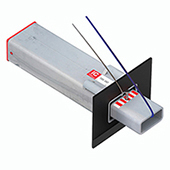 |
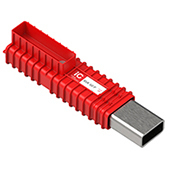
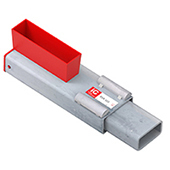
| Article no | Description | Capasity | Picture |
| TSS 20 FA | Stair flight to landing, connector with leveling adjustment. | 20 kN | 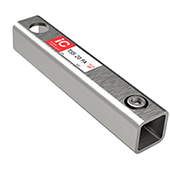 |
| TSS 25 L | Stair flight to landing, connector with leveling adjustment and lifting device. No need for additional local reinforcement. | 25 kN | 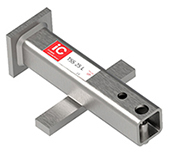 |
| TSS 60 P | Slim design allows thinner landings all the way down to ≥120 mm (full capacity 170 mm). Outer tube made of recycled HDPE. | 57 kN | |
| Article no | Description | Picture |
| IC Box 100 | Recess box, out-block. Made of 100% recycled HDPE | 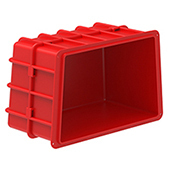 |
| IC Box 100 SRU | Recess box with SRU sound reduction, Recycled HDPE. | 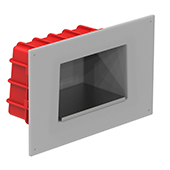 |
| Special made recess box for walls that is cast with sliding formwork. | 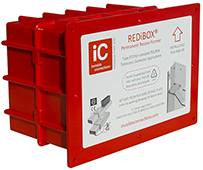 | |
| GF 25 GF 60 GF 100 GF 102 | Vertical rubberflenge 200x180x5 Vertical rubberflenge 240x190x5 Vertical rubberflenge 240x190x5 Vertical rubberflenge 240x190x5 |  |
| Cover TSS 101 | Cover for sealing during storage and transport RVK/TSS 101 Cover for sealing during storage and transport TSS 102 | 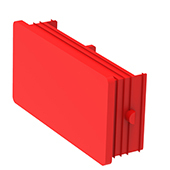 |
| Recess block RVK/TSS | Recess block RVK/TSS Recess block w magnet RVK/TSS | 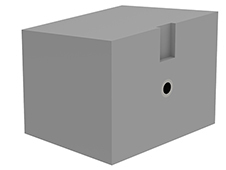 |
| Which model and capacity to choose ? | |
Our calculation tool helps you to find the correct model Ideas! TSS/RVK should be located as close to the front edge as possible to avoid uplift/negative forces in the rear end of the element. | 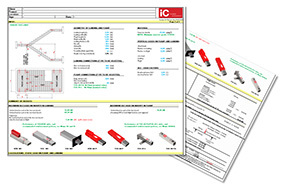 |
Reinforcement of stair connectors TSS/RVK landing-wall | |
| Standardized local reinforcement for TSS/RVK, see Memo 55, TSS / RVK, reinforcement | 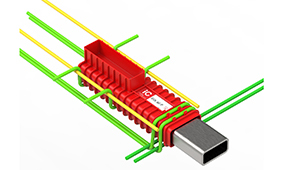 |
| TSS 25 L, see Memo 65A TSS25L no need for additional local reinforcement, the backplate and flat steel is enough. Vertical load 25 kN, | 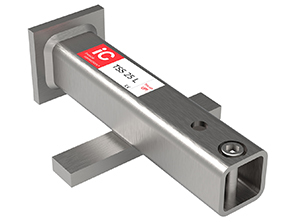 |
| TSS 20 FA, see Memo 65 | 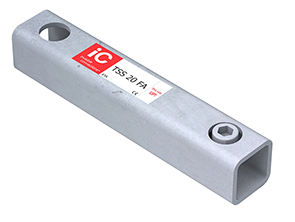 |
Slab thickness and edge distances
Se Memo 55, TSS / RVK, reinforcement
a) without simultaniously acting horizontal design support reaction.
b) with simultaniously acting horizontal design support reaction.
| Product series | Slab thickness (mm), a) | RVK 60 P | TSS 60 P | TSS 101 TSS 101 G | RVK 101 RVK 101 G | TSS 102 TSS 102 G |
| Load category a) | ||||||
| 120 | 34 | 34 | - | - | - | |
| 150 | 46 | 46 | - | - | - | |
| 170 | 57 | 57 | 96 | 96 | - | |
| 200 | 57 | 57 | 100 | 100 | 96 | |
| 265 | 57 | 57 | 100 | 100 | 100 | |
| Load category b) | ||||||
| 160 | 160 | 180 | 180 | 180 | ||
| 80 | 80 | 100 | 100 | 100 |
1) The TSS102 may in special cases fit into slabs with t=200mm if reduced concrete cover is acceptable. The unit should be placed centric in the slab, which will slightly reduce the height x8 below the minimum value stated in Table.
IC deliver several solutions for impact sound insulation, see Memo 47 and IC Academy film stair engineer.
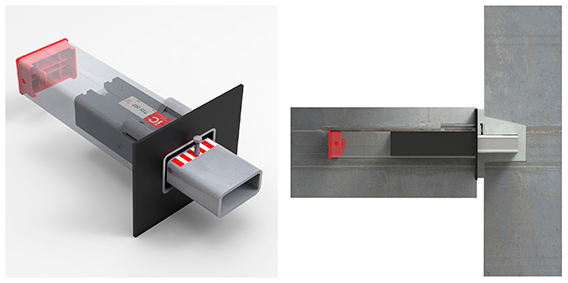 | TSS102 with vertical rubber flange, reduce sound impact by 20-25 dB. |
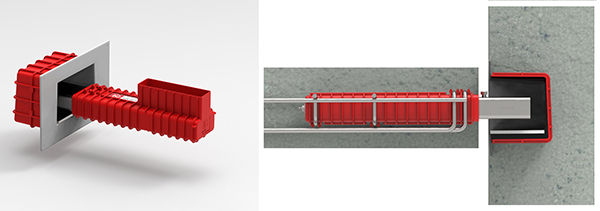 | TSS/RVK with IC Box 100 SRU, reduce impact sound by 20-28 dB. |
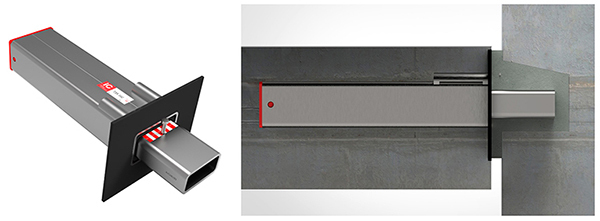 | TSS/RVK with vertical rubber flange, reduce sound impact by 10-12 dB. |
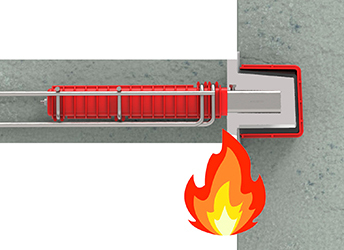 | Fire protection is taken care of in a good way when using IC stair connectors. After installation the TSS/RVK will be completely covered with concrete. Fire rating in accordance with Eurocode CEN/TC 250 |
| Required fire resistance | R30 | R60 |
| Minimum cover «C» mm (Norwegian regulations) | 25 | 40 |